
*This needs some serious editing, but that's unlikely to happen soon.*
The WashCycle blog has a nice interview with Randal O'Toole, a senior fellow at the Cato Institute. While he rides a little to the right of the path I like, he makes some excellent points.
One of his points is that bike-ped traffic enhancements are often intended to restrict or reduce automobile use, and he does not believe that this will be an effective strategy in the long run. He takes the point of view that planners are generally trying to funnel people's activities into specific channels: bicyclists here, cars there, pedestrians over here. In addition, he says, many traffic calming techniques actually make bicycling more difficult rather than easier and safer.
In another article, he points out that planners are often trying to solve problems caused by previous the previous generation of planners. O'Toole is generally in favor of letting planner-free free-markets sort out transportation issues. At the moment, that means we need to build more and better roads.
To be perfectly honest, he's right about a lot of things. This is painful to acknowledge, but the alternative, to maintain a comfortable fantasy, is clearly not the the right way to go.
Now, we still need to keep our spirits high, and to do this, we have to have a goal. It's all to easy to build a Lego city where pedestrians rule the roads and bicycles are primary vehicular choice, but to the extent that New Urbanism looks like the Garden City movement, it ain't good. I keep thinking back to the beatified Jane Jacobs, who was something of an anti-planner herself. The Great Cities, she said, maintain a kind of mystical ordered chaos. They are dynamic, always changing, and they have a defiant quality. Cities are swarms of human activity. They are alive, and the metaphor of life can be drawn out further--a city can be healthy, sick, dying, or even dead.
Cities are also collections of individuals, so the notion of health has two distinctive elements. One is the health of the collective: the ability of the city to sustain itself. Sustainability is a hip phrase these days, and rightly so. It is one of the distinctive features of life itself. Its importance depends on several assumptions related to life, the universe, and everything, so I'll just skip ahead. The second element of city health is the health of the individuals who make up the city. Here it is important to make sure our metaphor is based on life outside Kingdom Animalia, cities are more like plants or fungus or algae, rather than a person or dog. You can cut a city in half, and you get two smaller cities. They might die, but they might live too. And after a mashup like that, they are likely to change in ways we may not be able to predict.
Anyway, I'd like to get back to the bike project. No time, no time. Rush rush rush.
Showing posts with label transportation. Show all posts
Showing posts with label transportation. Show all posts
Thursday, November 8, 2007
Saturday, October 20, 2007
Workcycle in Alexandria, Virginia
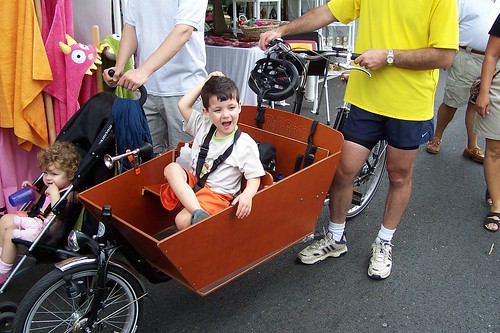 This image belongs to rllayman, originally uploaded by %2.
This is great news. Richard Layman posted this last week. If you haven't read his stuff, get on over there: Urban Places and Spaces I'm glad people like him keep track of what going on, because I know I can't manage to do it.
 Labels:
bakfiets,
cargo bikes,
DC,
family cycling,
transportation,
urban
Labels:
bakfiets,
cargo bikes,
DC,
family cycling,
transportation,
urban
Saturday, October 6, 2007
Advocacy and Transportation
- Best Workplaces for Commuters (EPA)
- Bicycle Transportation Institute
- Bike Arlington (NOVA)
- Bike Commuters
- BTA (Portland)
- C.I.C.L.E. (LA)
- Car Free DC
- Chicagoland Bicycle Federation
- Commute by Bike
- National Center for Bicycling and Walking
- National Center for Safe Routes To School
- Pedestrian and Bicycle Information Center
- Safe Routes to School National Partnership
- International Bicycle Fund (hub)
- League of American Bicyclists
- Thunderhead Alliance (hub)
- Transportation Alternatives (NYC)
- Velo Vision
- WABA (DC)
Labels:
advocacy,
transportation
Wednesday, August 29, 2007
We Ride in a Liminal Space
Here's one that was written a while back inresponse to some posting somewhere. I can't decide whether to call it "The American Pedestrian," or "A Cowboy Without A Horse," or something else. Without being explicit about it, this is the justification for cyclist violating traffic laws, like running stop signs and red lights, and why counter-cultures are important. There is more to say about this last bit though, because staying too long in the liminal space is tantamount to refusing to grow up, or being adolescent, or just naive. Paul Farmer and Susan Sontag, come on down...
We're all about radical acceptance and ruthless pragmatism now. That's the new thinking, and it really is different from the old thinking.
-----------------------------
Cars take up so many resources that all the other modes of tranportation get ignored. For peds, it's a bummer. A person walking is virtually defenseless, and really can't get very far, very fast. The American pedestrian is a cowboy without a horse.
A person with a bike, on the other hand, is perfectly scaled to the urban environment. She can get herself where she needs to go, squeeze through tight spots and traffic jambs, sprint out of harm's way, and generally have a good time doing it (and get a decent workout).
Cars are regulated because they kill people on a regular basis. When bikes start doing that, I'll be happy to pay my registration fee and sit for a license. It's nice to inhabit a liminal space. It is the traditional hang-out of the Other, and the locus of freedom in increasingly commodified culture.
And that's why bicycle culture is great.
That's the point: stop whining. Get a bike.
----- End forwarded message -----
Labels:
community,
liminal space,
transportation,
urban,
writing
Subscribe to:
Posts (Atom)


 Posts
Posts

